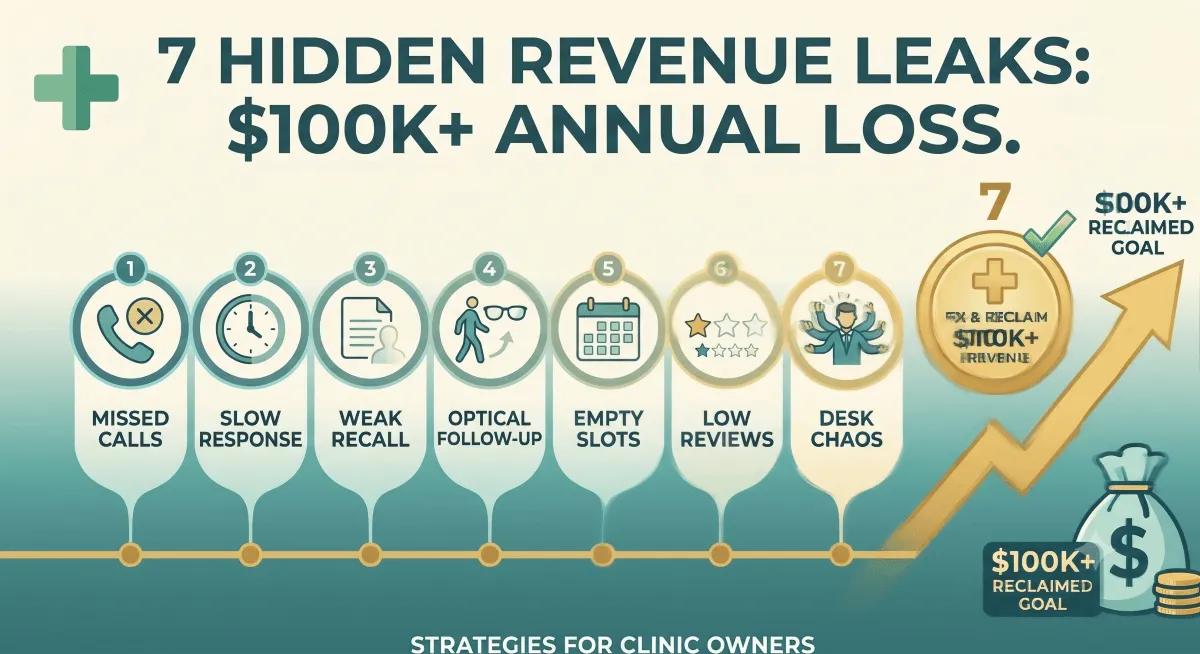
7 Hidden Revenue Leaks Most Owners Overlook
How Optometry Clinics Lose $100k+ Per Year Silently: 7 Hidden Revenue Leaks Most Owners Overlook
Running an optometry clinic can feel a little like trying to keep ten spinning plates balanced at the same time.
One minute your team is helping a patient choose frames. The next, the phone is ringing, someone’s asking about insurance, another patient is checking in, and a website inquiry just landed after hours.
From the outside, things may look busy and productive. Revenue might even seem stable.
But behind the scenes, something quieter is happening.
Money is leaking out of the business in small, almost invisible ways.
Not because the clinic lacks patients.
Not because the doctors aren’t skilled.
And not because the staff doesn’t care.
It happens because tiny operational gaps—when repeated every day—turn into massive annual revenue loss.
And here’s the surprising part:
Most optometry clinics don’t realize how much money they’re losing until they finally measure it.
By then, the lost revenue can easily exceed six figures annually.
Let’s talk about the 7 hidden revenue leaks most clinic owners overlook—and how modern practices are fixing them before they quietly drain another year of growth.
The Real Problem: Most Optometry Clinics Don’t Need More Leads First
When growth slows down, the first instinct is usually to crank up marketing.
Maybe it’s:
Running more ads
Hiring a social media agency
Redesigning the website
Investing in SEO
Launching promotions
Posting more on Instagram
And sure, sometimes those things help.
But here’s the truth most clinic owners eventually discover:
The problem often isn’t a lack of demand.
It’s that the clinic already has opportunities coming in… but too many of them slip through unnoticed.
Think about it this way.
Imagine pouring water into a bucket with holes in the bottom. Adding more water helps temporarily—but fixing the leaks changes everything.
That’s exactly what happens in many optometry clinics.
Before spending thousands to generate more leads, it often makes sense to protect the opportunities already knocking on the door.
1. Missed Calls Quietly Cost New Patients
This one happens constantly.
The front desk is slammed. Patients are arriving. Someone needs help adjusting frames. Insurance questions are piling up.
And meanwhile?
The phone rings.
Nobody answers.
The potential patient hangs up and calls the next clinic.
That’s it. Gone.
The scary part is how fast this adds up.
Let’s say your clinic misses:
4 potential new patient calls per week
Only 2 of those would have booked
Average first-year patient value is around $1,500
That’s roughly:
$3,000 per week
$12,000 per month
Over $40,000 annually
And those numbers are actually conservative for many clinics.
The painful part?
You may have already paid to generate that lead through referrals, SEO, Google ads, or reputation-building.
The patient was ready.
The system simply failed to catch them.
Why This Happens
Most front desk teams are overloaded, not underperforming.
They’re juggling:
Check-ins
Scheduling
Payments
Insurance verification
Walk-ins
Optical support
Phone calls
Even strong teams miss calls when interruptions pile up.
How Smarter Clinics Fix It
Modern clinics are implementing:
Missed-call text-back systems
Overflow call handling
AI-powered call routing
Online scheduling options
Automated voicemail follow-ups
The goal isn’t replacing staff.
It’s reducing the pressure on them.
2. Slow Response Times Kill Online Conversions
Patients today expect speed.
And honestly? Companies like Amazon, Uber, and Netflix trained all of us to expect instant responses everywhere.
So when someone submits a website inquiry at 7:30 PM and doesn’t hear back until the next afternoon, they often move on.
Most patients compare multiple clinics before booking.
The first clinic that responds usually wins the conversation.
Not always because they’re better.
But because they were faster.
A Story Most Clinics Relate To
A patient searches:
“best eye exam near me”
They visit three clinic websites.
Two have contact forms.
One responds immediately with:
Appointment availability
A friendly text
Easy scheduling options
Guess who gets booked first?
Convenience wins more often than clinic owners realize.
The Hidden Cost
Slow response time quietly lowers:
Lead conversion rates
New patient bookings
Website ROI
Advertising ROI
The interest existed.
The delay killed momentum.
Simple Ways Clinics Improve This
Growing practices now use:
Instant lead notifications
Automated text replies
Online booking tools
After-hours response systems
CRM follow-up automation
Even shaving response time from 12 hours to 5 minutes can dramatically improve conversion.
3. Weak Recall Systems Let Existing Patients Disappear
This may be the biggest hidden revenue leak in optometry.
Because recall patients are already warm.
They already know your clinic.
They already trust your doctors.
And many already intend to come back.
But life gets busy.
People forget.
Without a reliable recall system, patients slowly disappear year after year.
What Usually Happens
The clinic sends:
One reminder email
Maybe one text
Possibly one phone call
Then the patient slips into an overdue list nobody has time to manage.
Months pass.
Then years.
Eventually, they book somewhere else.
Why This Hurts So Much
Acquiring a brand-new patient is expensive.
Retaining an existing patient is far easier and more profitable.
And yet many clinics unknowingly spend more energy chasing new traffic than protecting existing relationships.
Signs Your Recall System Needs Help
Overdue patient lists keep growing
Recall calls happen inconsistently
Staff are too busy for follow-ups
No-shows increase
Annual exams decline
How Successful Clinics Handle Recall Today
They automate consistency.
That includes:
Multi-touch reminders
SMS recalls
Email campaigns
Automated overdue follow-up
Reactivation workflows
Personalized reminders
The key isn’t “working harder.”
It’s making follow-up predictable.
4. Eyewear Sales Walk Out the Door Every Day
This one is sneaky because it doesn’t feel like a “lost sale” in the moment.
A patient finishes their exam.
They browse frames for a few minutes.
Then they say:
“I’ll think about it and come back later.”
But many never return.
Not because they didn’t like the clinic.
Not because they hated the pricing.
Usually because nobody followed up.
The Revenue Leak Most Clinics Underestimate
Without a post-visit optical follow-up system, clinics quietly lose:
Prescription eyewear sales
Lens upgrades
Second-pair purchases
Prescription sunglasses
Contact lens conversions
Even missing a few optical sales weekly can create tens of thousands in annual lost revenue.
What Patients Actually Need
Not pressure.
Just guidance and convenience.
Sometimes a simple:
Follow-up text
Frame reminder
Insurance benefit reminder
“Still interested?” message
…is enough to recover the sale.
Modern Optical Teams Use
Automated follow-up reminders
Abandoned optical workflows
Insurance expiration reminders
Personalized frame recommendations
Text-based communication
And surprisingly, patients often appreciate the reminder.
5. Empty Appointment Slots Are More Expensive Than Most Owners Think
Every clinic deals with cancellations and no-shows.
That part is unavoidable.
The real question is:
What happens after the cancellation?
In many clinics…
Nothing.
The slot stays empty.
The doctor sits idle.
Payroll continues.
Production goals drop.
And the day quietly underperforms.
One Empty Slot Doesn’t Feel Serious
But repeated daily?
It becomes expensive fast.
Even one unused appointment slot per day can translate into tens of thousands annually.
The Clinics Winning Here Use Systems
Instead of scrambling reactively, they use:
Waitlists
Same-day fill workflows
Automated cancellation alerts
Reactivation lists
Quick-text scheduling systems
When a cancellation happens, they immediately contact patients already waiting for earlier availability.
Simple. Effective. Profitable.
6. Weak Reviews Quietly Reduce New Patient Growth
Here’s something many clinic owners don’t love hearing:
Patients judge clinics online before they ever visit.
Even if your care is outstanding.
When comparing practices, people often look at:
Star ratings
Review count
Review recency
Ease of booking
Website experience
And if another clinic appears more active online, patients often choose them first.
The Frustrating Part
Many excellent clinics lose patients to competitors with:
Worse service
Less experience
Lower-quality care
…simply because they look more trustworthy online.
Why Reviews Matter So Much
Reviews build:
Social proof
Trust
Credibility
Visibility in local search
In fact, strong reviews can directly improve local SEO rankings. For example, businesses with consistent Google reviews often perform better in local search visibility according to Google Business Profile Help.
How Smart Clinics Grow Reviews Consistently
They don’t “hope” reviews happen.
They systemize them with:
Automated review requests
SMS review links
Post-visit follow-ups
Team accountability
Reputation monitoring
Consistency matters more than volume spikes.
7. Front Desk Burnout Creates Operational Chaos
This is important:
Most operational problems are not caused by lazy staff.
Usually, the team is overwhelmed.
Front desk employees in optometry clinics often juggle:
Phones
Scheduling
Insurance questions
Walk-ins
Optical support
Reviews
Recall calls
Payments
Reschedules
All day long.
Interruptions become constant.
And eventually, inconsistency appears:
Missed calls
Delayed responses
Scheduling errors
Forgotten follow-ups
Poor patient experiences
The Mistake Many Owners Make
They assume:
“We just need more staff.”
Sometimes that helps temporarily.
But often the bigger issue is broken workflows.
Adding more people to a chaotic system can actually multiply inefficiency.
What High-Performing Clinics Focus On Instead
They improve systems first:
Clear workflows
Automation
Task delegation
Communication tools
Scheduling efficiency
Process documentation
When systems improve, burnout decreases naturally.
What $100k+ in Lost Revenue Can Actually Look Like
Here’s where it gets eye-opening.
These leaks don’t require catastrophic failure.
Just small, repeated inefficiencies.
Revenue LeakMonthly LossAnnual LossMissed new patient calls$3,500$42,000Lost recall exams$2,500$30,000Missed optical sales$2,000$24,000Weak review conversion$1,000$12,000Total$9,000$108,000
That’s over six figures quietly disappearing without most owners noticing.
How Modern Optometry Clinics Are Fixing These Problems
The fastest-growing clinics today are not always the ones spending the most on marketing.
They’re often the ones creating smoother systems.
Here’s what many are implementing:
Instant missed-call text-back
After-hours lead response
Automated recall campaigns
Same-day cancellation fill workflows
Review generation systems
Optical follow-up reminders
Monthly KPI dashboards
Online self-scheduling
These tools reduce chaos while improving patient experience at the same time.
And that’s the real win.
The New Competitive Edge in Optometry
Years ago, clinics mostly competed on:
Location
Insurance acceptance
Product selection
Pricing
Reputation
Today, patients also care deeply about:
Speed
Convenience
Communication
Ease of booking
Follow-up consistency
The clinic that makes life easier often wins.
Even in competitive markets.
Quick Optometry Clinic Self-Audit
Ask yourself honestly:
How many calls were missed last month?
How quickly are website inquiries answered?
How many overdue recall patients are inactive?
How many patients leave without buying eyewear?
How often do cancellations create empty exam slots?
Are reviews increasing every month?
If those answers aren’t clear, there’s a good chance hidden revenue leaks already exist.
Frequently Asked Questions
How do optometry clinics lose revenue without noticing?
Most revenue leaks happen gradually through missed calls, poor follow-up, weak recall systems, cancellations, and lost optical sales. Small operational gaps repeated daily create major annual losses.
What is the biggest hidden revenue leak in optometry clinics?
Many experts consider weak patient recall systems the biggest leak because annual exam patients are easier and less expensive to retain than acquiring new patients.
How can optometry clinics reduce missed calls?
Clinics often improve call capture using missed-call text-back systems, overflow support, online scheduling, and better front desk workflows.
Why are online reviews important for optometrists?
Reviews strongly influence patient trust, local SEO visibility, and booking decisions. Patients frequently compare clinics online before scheduling appointments.
How do cancellations impact clinic profitability?
Empty appointment slots reduce doctor productivity while payroll and overhead continue. Same-day fill systems help minimize lost production.
Should clinics focus on marketing or operations first?
In many cases, improving operations first creates a better return because clinics stop losing existing opportunities before spending more to generate new ones.
Final Thoughts
Most optometry clinics don’t lose $100k+ because of one dramatic mistake.
They lose it quietly.
One missed phone call.
One delayed reply.
One overdue recall patient.
One patient who never comes back for glasses.
One empty appointment slot at a time.
And that’s what makes these problems dangerous.
They’re easy to ignore because each moment feels small.
But together?
They shape the growth, profitability, and stability of the entire clinic.
The optometry practices that grow fastest over the next few years likely won’t just market harder.
They’ll operate smarter.